

Search
-
or select -


Elk Grove Acura Service Department
A warning light is a symptom, not a diagnosis. Our Acura-certified technicians read what the vehicle is actually reporting, then tell you what it means and what it will take to fix.
Schedule Service Online Call Service: (877) 707-7834This is what almost everyone wants to know before anything else, and the answer is usually visible from the driver's seat. Look at how the light is behaving.
A steady, solid light means the engine management system has stored a fault. It is telling you something needs attention, not that the vehicle is in danger. In most cases you can finish your drive and book an appointment in the next few days. Drive normally, avoid towing or hard loads until it is read, and pay attention to whether anything else changes.
A flashing light is different, and it is the one case that is urgent. A blinking check engine light generally indicates a misfire severe enough to dump unburned fuel into the exhaust, which can destroy the catalytic converter in a short distance. Reduce speed, stop driving as soon as you can do so safely, and have the vehicle looked at rather than continuing your trip. A converter is one of the more expensive parts on the car, and this is the one situation where a few miles genuinely matters.
Common, and usually not urgent. Something is outside its expected range. Book an appointment in the next few days and drive normally in the meantime.
Treat as urgent. An active misfire can damage the catalytic converter quickly. Reduce speed and stop driving as soon as it is safe to do so.
Have it seen promptly even if the light is steady. Symptoms you can feel mean the fault is affecting how the engine runs right now.
Check that the fuel cap clicked shut. A loose cap is a genuine and very common cause, and the light often clears itself after a few drive cycles once it is tight.
Stop. Those two warnings are about immediate mechanical damage and they override everything above. Pull over safely and call rather than driving in.
The fault stopped recurring, but the code is still stored. It will usually return. Worth reading at your next visit so you know what it was.
Plenty of places will plug in a handheld scanner and hand you a code for nothing. That is a useful first data point and we are not going to pretend otherwise. But it is worth understanding exactly what you have been given, because the gap between a code and a repair is where most wasted money happens.
A stored code names a circuit or a condition, not a broken part. P0420 does not mean "replace the catalytic converter" — it means the computer is seeing readings from the downstream oxygen sensor that fall outside the expected range. That can be a failing converter. It can equally be a failing sensor, an exhaust leak ahead of the sensor, or a fuel trim problem originating somewhere else entirely. Replace the converter on the strength of the code alone and you may well still have the light a week later, minus the cost of the part.
What turns a code into a diagnosis is live data: watching fuel trims, sensor voltages and the freeze-frame conditions captured at the moment the fault was stored, then testing the circuit rather than inferring from it. That is the difference between a parts-store readout and a technician telling you what is actually wrong.
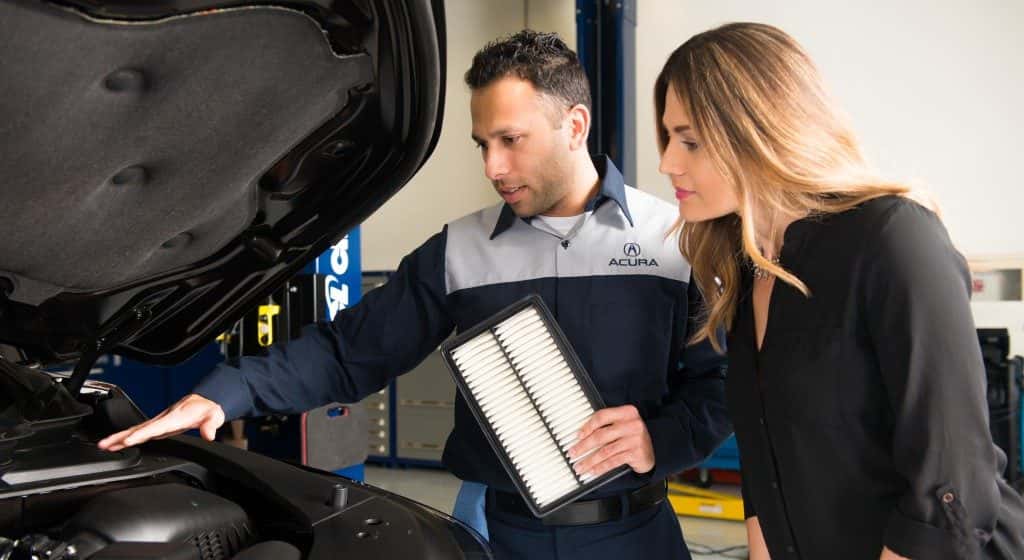
Diagnosis on a modern Acura is a procedure, not a plug-in. The sequence matters because each step narrows what the next one has to consider.
Factory equipment interrogates every module on the vehicle, not only the engine controller. Modern Acuras run dozens of them, and a check engine light can be set by a fault whose root cause sits in a system you would never associate with the engine. A generic scanner reads the engine module and stops there.
When a fault stores, the computer captures a snapshot of conditions at that instant: engine speed, load, coolant temperature, fuel trim. Cold start or fully warm, idling or at highway load, those details point at very different causes for the same code. Then we watch the relevant values live while the engine runs.
A sensor reporting an implausible value might be faulty, or it might be reporting accurately about a genuine problem, or its wiring might be damaged. Those three possibilities lead to three completely different repairs, and telling them apart means testing rather than assuming.
Acura publishes bulletins on faults that turn out to be common on particular models and model years, often with a known cause and a defined fix. We check those against your VIN as a matter of course, along with any open recall or extended warranty coverage. That check occasionally turns a repair into a no-charge item, which is a good reason not to skip it.
You hear what the fault is, what caused it, what the repair involves and what can reasonably wait. Nothing is replaced without your authorization.
The list below is not a diagnosis of your vehicle, and it is deliberately not a checklist to work through yourself. It is here so you have a realistic sense of the range, because "check engine light" covers everything from a thirty-second fix to genuine engine work.
The evaporative emissions system is sealed and pressure-tested by the vehicle itself, so it notices a cap that was not tightened properly. This is the single most common harmless cause, and it is worth eliminating before you book anything.
These age. Sensors drift out of specification over a long life, converters lose efficiency, and the two set similar codes, which is exactly why the distinction has to be tested rather than assumed.
Usually ignition coils, spark plugs or fuel delivery. A misfire is what sets a flashing light, and on Acura's V6 engines a single failing coil is a common and straightforward cause.
Acura engines use variable valve timing extensively, and the solenoids and oil control valves that drive it can set faults. These are also sensitive to oil condition and level, which is one of several reasons oil service intervals matter more on these engines than people assume.
On turbocharged models, boost pressure sensors, wastegate control and charge air leaks all have their own fault codes, and a small leak can produce a light without any obvious symptom.
Some Acura models display this message rather than, or alongside, the light. It means the same thing: the emissions-related monitoring system has stored a fault. It is diagnosed exactly the same way.
These two get mixed up constantly, and they mean opposite things.
The Maintenance Minder is scheduled work. It counts down based on how the vehicle has actually been driven and then displays a service code — an A or B followed by numbers — telling you which items are due. Nothing is wrong. It is the car asking for routine maintenance at the right moment rather than at a fixed mileage. Our guide to what each Acura maintenance code means covers those in full.
The check engine light is unscheduled. Something has been detected outside its expected operating range, and no amount of routine service will clear it until the underlying fault is found and repaired.
One follows a schedule; the other does not wait for one. If both are showing at once, they are two separate conversations, and the light is the one that sets the timeline.
Current service offers are listed on the service specials page.
Diagnostic service covers the current and recent Acura lineup, including turbocharged, hybrid and all-electric models.
Every module on the vehicle is read, with access to manufacturer data a generic scanner cannot reach.
Factory-trained on these engines and these systems, rather than working from a generic code lookup.
Your VIN is checked against Acura bulletins, open recalls and extended coverage, which sometimes changes the answer entirely.
A code narrows the search. Testing finds the fault. You do not pay for parts fitted on a guess.
If a repair is needed, it is done with components built for the vehicle and documented to factory standards.
Findings explained in plain terms, with what is urgent separated from what can wait. Nothing proceeds without your say-so.
We serve drivers from Elk Grove, Sacramento, Roseville, Stockton, Modesto and Fairfield, and from Davis, West Sacramento and Woodland on the west side of the Causeway.
If the light is steady and the vehicle drives normally, you can generally finish your drive and book an appointment within the next few days. Avoid towing or heavy loads until it has been read. If the light is flashing, treat it as urgent: that usually indicates a misfire that can damage the catalytic converter within a short distance, so reduce speed and stop driving as soon as it is safe.
A flashing light indicates an active misfire severe enough that unburned fuel is reaching the exhaust. That can overheat and destroy the catalytic converter quickly, which makes it the one check engine situation where continuing to drive materially increases the cost of the repair. Stop as soon as you safely can and have the vehicle looked at rather than driving on.
Yes, and it is one of the most common harmless causes. The evaporative emissions system is sealed and the vehicle pressure-tests it, so a cap that was not tightened until it clicked will set a fault. Tighten it properly and the light will often clear by itself after a few drive cycles. If it does not, the fault is somewhere else in the system and needs reading.
The light goes out when the fault stops recurring, but the code stays stored in memory. Intermittent faults almost always come back, usually under the same conditions that triggered them the first time. It is worth having the stored code read at your next visit so you know what it was and whether it matters.
No, and they mean opposite things. The Maintenance Minder counts down scheduled maintenance based on how the vehicle has been driven and displays a letter-and-number service code when routine work is due; nothing is wrong. The check engine light means a fault has been detected outside normal operating range. Routine service will not clear it.
It means the same thing as the check engine light. Some Acura models display this message instead of, or in addition to, the light when an emissions-related fault is stored. It is read and diagnosed exactly the same way, and it covers the same wide range of possible causes.
An illuminated check engine light is an automatic failure in California, regardless of what set it. The readiness monitors also need to have completed, and clearing a code resets them, so having the code erased shortly before an inspection causes a failure of its own. The right sequence is to repair the underlying fault first, then drive the vehicle enough for the monitors to complete, then test.
Yes. Diagnosis, warranty work and open recalls are handled here regardless of where the vehicle was purchased, for drivers from anywhere in the Sacramento area.
Book online in under a minute, or call and tell us whether the light is steady or flashing — that one detail changes how quickly we need to see you.
Schedule Service Online Call Us: (877) 707-7834